For organisations

Using humour at work deliberately.

Science-based training, workshops and keynotes for leaders and teams on humour, communication and collaboration.

De:Humore is Dr Bastian Mayerhofer’s platform for humour research and its practical application.

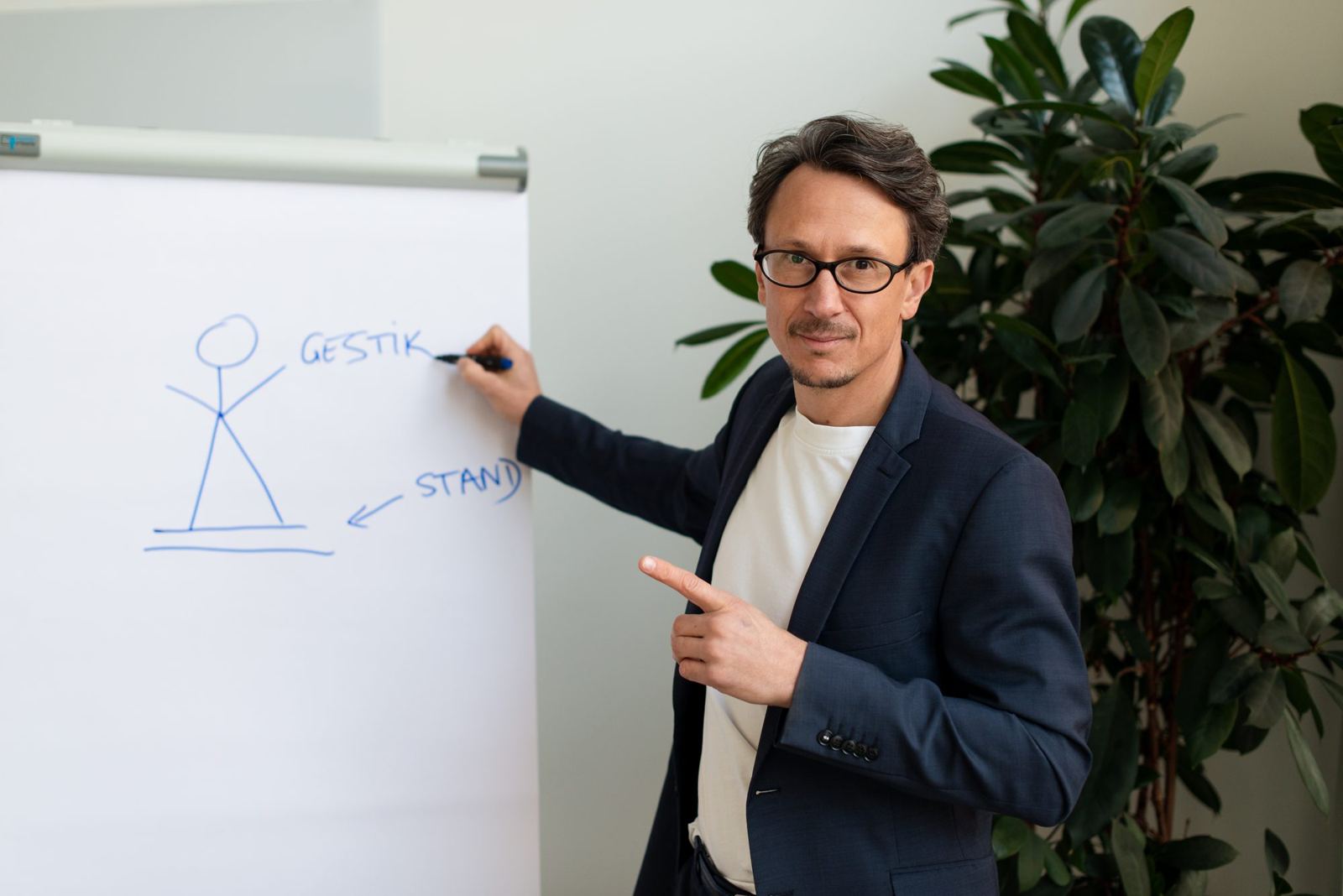
Dr Bastian Mayerhofer explaining something on a flip chart during a training session

From everyday working life

Does this sound familiar?

  • “Open error culture” is on the slide. Yet the meeting still goes quiet when something goes wrong.What makes mistakes something you can talk about day to day?
  • Leaders want to seem approachable without being forced funny.How much lightness suits your own role?
  • A joke is meant to bring people together. Part of the team laughs, another part looks away.Why does the same sentence land so differently?
  • Meetings and presentations run correctly, but hardly anyone is really engaged.What creates presence and participation?

Humour can connect people, open up perspectives and shape conversations. But it can also hurt, exclude or reinforce hierarchies. How it works depends on, among other things, the person, the relationship, the situation, the aim and the organisational culture.

Areas of application

Where humour plays a role at work

01

Humour in leadership

Humour is part of communication and relationships. How do hierarchy, trust, timing and situation affect how a remark comes across? And what changes when the person with the most influence makes the joke?

Enquire about this topic for your leaders
02

Humour in teams and collaboration

Humour can create a sense of belonging. At the same time, it can exclude people or make roles and status visible. Teams learn to recognise these sides and deal with them consciously.

When humour can hurt: to the Humour Risk Check
03

Humour and error culture

How can teams look at mistakes and mishaps from a new perspective? One possible exercise is a reflective question like this:

“What was our biggest mistake in the last two weeks, and how could we have made it even worse?”

An exercise that can create some distance and get people talking. Whether it fits depends on the team and the situation.

Find the right format

State of research

What the research shows, and what it does not.

Meta-analyses find associations between positive humour and characteristics such as job satisfaction, commitment and team performance. These are correlations. They do not show that a training programme automatically produces these outcomes.

  • Humour can connect.
  • Humour can signal status.
  • Humour can shift tension.
  • Humour can cross lines.

What positive humour in organisations is associated with

+31%Job satisfactionhigher with more positive humour
+27%Team commitmenthigher with more positive humour
–36%Stress and burnout tendencieslower with more positive humour
+21%Team performancehigher with more positive humour

How to read these figures: the studies examined how positive humour at work is related to these characteristics. The percentages correspond to transformed effect sizes. They describe associations, not causes, and not guaranteed effects of a training programme.

Figures based on meta-analyses and reviews in organisational psychology (including Mesmer-Magnus et al., 2012; Martin, 2007; Cann & Kuiper, 2014).

The effect humour has in your organisation depends on the people, relationships, aims, situation and culture. That is exactly where the formats come in.


Research framework

The scientific perspectives behind the formats

The formats draw on several perspectives from humour research. None of them explains all humour. Together, they help you look at situations more closely.

“Analysing humour is like dissecting a frog.

Few people are interested and the frog dies of it.”

With the right disposition, it is a hell of a lot of fun.

After E. B. White. The reply underneath is by Dr Bastian Mayerhofer.
IncongruityBenign violationSuperiority and disparagementReliefPlaySocial and evolutionary perspectivesPersonality and humour stylesDe:Humore working model: prediction and correction

The De:Humore working model (Prediction → Error → Revision → Humour → Adaptation) is a working hypothesis and a formative perspective, but not an explanation for every form of humour.

Humour styles and personality serve as tools for reflection and conversation. Nobody is sorted into a type, and there is no diagnosis. Personality does not reliably predict how someone will react to humour.

Learning objectives

What participants can work on in the training

Not simply making more jokes. Understanding better what humour does in a situation.

Which objectives take centre stage depends on the format and on what you need.

  1. Reflect on different humour styles and their possible functions.
  2. Explore your own preferences and reactions to humour.
  3. Take aim, audience, relationship, power relations and situation into account.
  4. Compare humorous and non-humorous responses to work situations.
  5. Develop alternative perspectives and humorous reframings.
  6. Recognise limits and decide when humour is helpful or out of place.
  7. Transfer exercises to meetings, feedback conversations, leadership situations or presentations.

How we work

Understand the science. Try it out. Take it into everyday work.

  1. Clarify needs and contextWhat is going on in your organisation, who is taking part, and what should be possible afterwards that was not before?
  2. Put the research in clear contextRelevant findings and examples, prepared so that they connect with everyday working life.
  3. Practise, discuss, reflectExercises, conversations and reflective questions instead of a lecture.
  4. Develop the transferConcrete ideas for meetings, feedback, leadership and presentations.

Every format is tailored to your needs and your organisation.

Formats

From a single talk to ongoing support

Keynote or short talk

A sharp introduction to the topic of humour for conferences, leadership meetings or internal events.

Workshop or team training

Working together on a team situation: exercises, reflection and transfer into everyday work.

Tailor-made business training

Training designed around your goals, your target group and your organisational culture.

Coaching

One-to-one support that starts with how you yourself handle humour.

For leaders and individuals, and can also be booked through your organisation.

Online or in person, preferably in person. We agree duration, group size and structure to suit your needs and the format.

Dr Bastian Mayerhofer smiling and pointing upwards with both index fingers

About Dr Bastian Mayerhofer

Researching humour, and putting it into practice.

Dr Bastian Mayerhofer holds a doctorate in psychology and is a humour researcher and trainer. He combines research on humour and communication with practical work in training sessions, workshops and talks.

With De:Humore, he translates findings from humour research into formats that connect with everyday working life: clear, nuanced and with an eye on both potential and limits.

Full biography and speaker topics (in German)

Frequently asked questions

Good to know

Does a team have to be particularly funny?
No. It is not about who is the funniest. It is about understanding how humour works in your own team. That includes taking reticence and different preferences seriously.
Is the training about making more jokes?
No. The focus is on what humour does in a situation: whether it connects, eases tension, signals status or hurts. That leads to more conscious decisions, sometimes in favour of humour and sometimes against it.
How are limits and different reactions to humour taken into account?
Different reactions are part of the topic, not a disruption. The formats work with questions about aim, audience, relationship, power and situation. Nobody has to take part if it does not feel right, and humour at the expense of individuals is not practice material.
Can the content be adapted to a specific leadership or team situation?
Yes. In an initial call, we clarify your needs, the target group and the setting. Content, examples and exercises are then tailored accordingly.
What if humour is a sensitive subject in the team right now?
That is precisely when it can make sense to talk about it. The formats put effects and limits centre stage, not punchlines. In the initial call, we clarify what is currently going on in the team and how gently to begin.
Which formats are available?

Keynote or short talk, workshop or team training, tailor-made business training, and coaching for leaders or individuals.

All formats are available online or in person, preferably in person. We agree duration, group size and structure to suit your needs and the format. Coaching can also be booked through your organisation.

Enquiry

What would you like to work on with humour?

Let us work out together whether a talk, workshop, training or coaching is right for your organisation.

Use the form to describe what you need in writing and you will receive a reply. Prefer to talk directly? Then book a 15-minute introductory call. Or write to bastian@dehumore.com.

All fields except “Preferred timeframe” are required. Your details will only be used to process your enquiry. More in the privacy policy (in German).

Jetzt zum Newsletter anmelden & ein kostenloses E-Paper "10 Humor-Hacks für mehr Leichtigkeit" erhalten

Du kannst dich jederzeit mit einem Klick abmelden.
Deine Daten bleiben bei mir – sicher, vertraulich und ausschließlich für den Newsletter gedacht. Zero Spam. Nur Leichtigkeit, Humor & Cognitive-Science-Impulse.